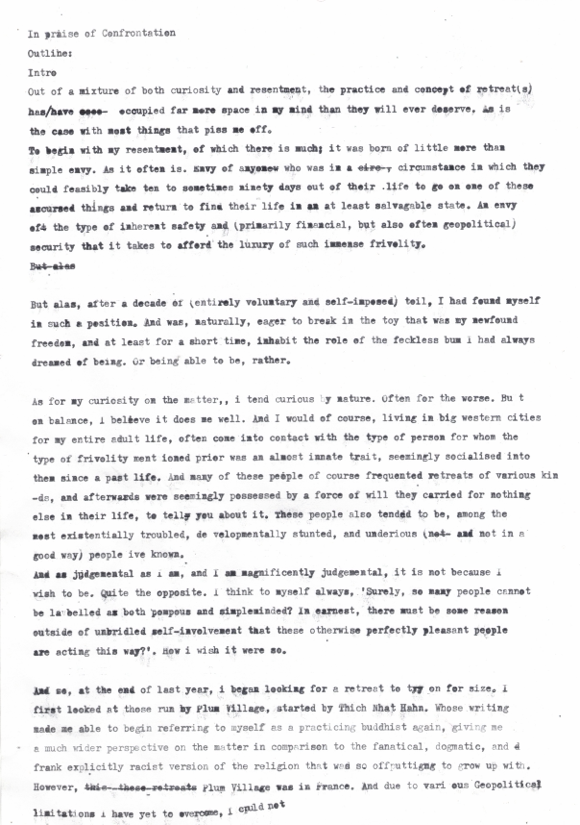
Out of a mixture of curiosity and resentment, the practice and concept of retreat has occupied far more space in my mind than it will ever deserve. As is the case with most things that piss me off.
To begin with my resentment, of which there is much; it is born of little more than simple envy. As is often the case. Envy of anyone in possession of circumstances which allow them to feasibly take ten to sometimes ninety days out of their life to go on one of these accursed things and return to find their life in an at least salvageable state. An envy of the type of inherent safety and (primarily financial, but also often geopolitical) security that it takes to afford the luxury of such immense frivolity.
But alas, after a decade of (entirely voluntary and self-imposed) toil, I had found myself in such a position. And was, naturally, eager to break in the toy that was my newfound freedom. And at least for a time, inhabit the role of the feckless bum I had always dreamed of being. Or of being able to be, rather.
As for my curiosity on the matter, I tend curious by nature. Often to my detriment. But on balance, I believe it does me well. And I would of course, living in big western cities for most of my adult life, often come into contact with the type of person for whom the type of frivolity mentioned prior was an almost innate trait, seemingly socialised into them since a past life. And an alarming subset of these people frequented retreats of various kinds, and afterwards were seemingly possessed by a force of will they carried for nothing else in their life, to go on about them incessantly. These people also tended to be, among the most existentially troubled, developmentally stunted, and unserious (and not in a good way) people I’ve known.
As judgemental as I am, and I am magnificently judgemental, it is not because I wish to be. Quite the opposite. I think to myself always, “Surely, so many people cannot be labelled as both pompous and simpleminded? In earnest, there must be some reason outside of unbridled self-involvement that these otherwise perfectly pleasant and moderately interesting people are acting this way?” If only it were so.
And so, at the end of last year, I began looking for a retreat to try on for size. I first looked at those run by Plum Village, a Buddhist monastery started by Thich Nhat Hahn, whose writing was the beginning of me being able to refer to myself as a Buddhist again. It gave a much wider perspective on the matter in comparison to the fanatical, myopic, and racially essentialist version of the religion I grew up with back home. However, Plum Village was in France, and due to various geopolitical factors alluded to prior, I could not afford any more days out of the country than I absolutely needed to for work. So I very lazily signed up for the one in closest proximity to me. The shuttle set off a ten minute walk away from my old place.
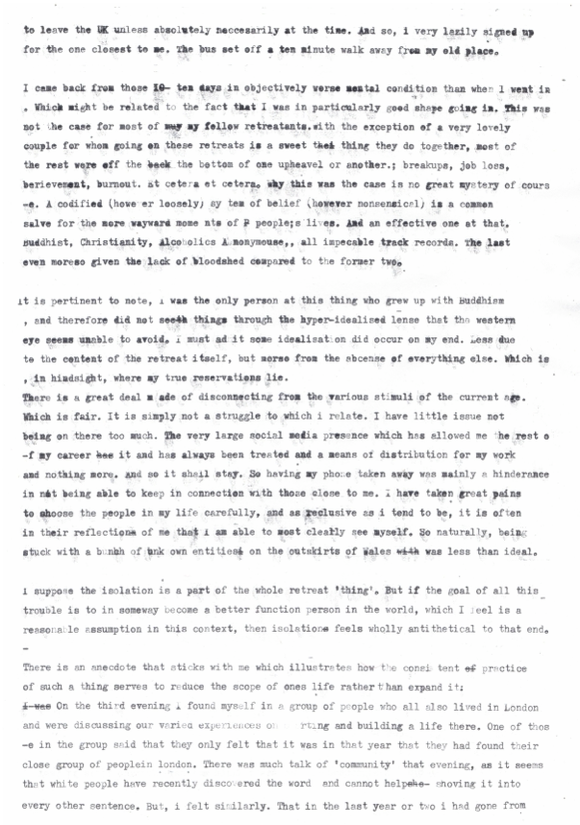
I came back from those ten days in objectively worse mental condition than I went in. Which in part might be related to the fact that I was in particularly good shape going in. This was, with respect, not the case for most of my fellow retreatants. With the exception of a very lovely couple for whom these retreats were a sweet thing they went on together every so often, most of the rest were bouncing off the bottom of one upheaval or another: breakups, redundancy, bereavement, burnout. Et cetera, et cetera. Why this was the case is no great mystery. A codified (however loosely) system of belief (however nonsensical) is a common salve for the more wayward moments of people’s lives. And an effective one at that.
Buddhism, Christianity, Alcoholics Anonymous. All impeccable track records. The last even more so, given its lack of bloodshed in its name compared to the former two.
It is pertinent to note, I was the only person at this thing who grew up with Buddhism, and therefore did not see things through the hyper-idealised, inevitably-exoticised lens that the western eye seems unable to avoid. Less due to the content of the retreat itself, and more so the absence of all else. Which is where my true reservations begin.
There is a great deal made of disconnecting from the various stimuli that are resultant from currently ubiquitous technologies. Mainly around the importance of, and difficulty in, doing so at all. And in this context, I imagine being divorced from one's phone temporarily to offer an amount of great relief. However, this particular difficulty of addiction to entertainment on the device is not something I am very prone to, and manage to prune my use of it mainly to keeping as close as I can to those in my life I cannot physically be around as much as I’d like. I have taken great pains to choose and nurture the close relationships in my life, and as reclusive as I am, it is often in those people’s reflections of me that I am able to most clearly see myself. So naturally, I found the complete disconnection from them to be a bit disconcerting to say the least. Especially given that my alternative was being stuck with a bunch of strangers on the outskirts of Wales.
The isolation is much of the point of a retreat, but if the goal of all this trouble is to in some way become a better functioning person in the world, which I feel is a reasonable assumption to make in this context, then isolation from the world to reach this end seems an incredibly counterintuitive path to take.
There is an anecdote from a conversation I had while there which I believe illustrates how the consistent practice of such a thing serves to reduce the scope of one's life, rather than expand it.
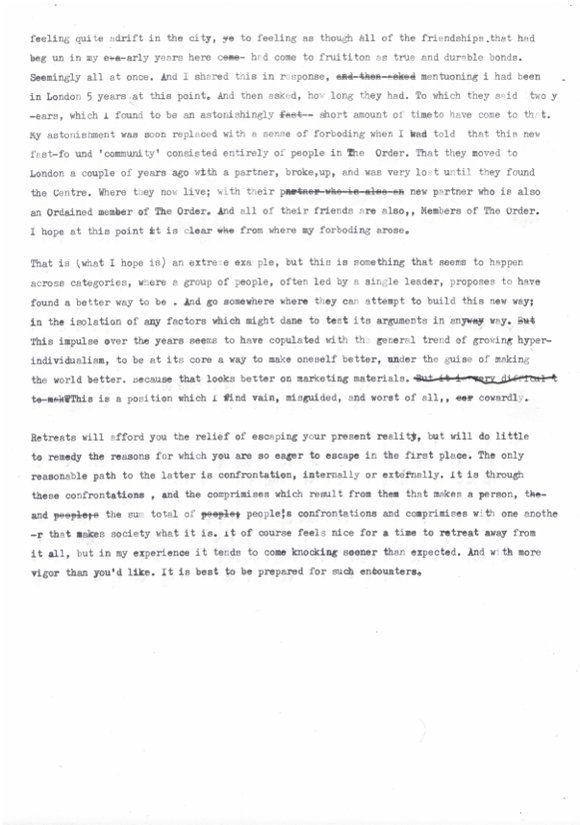
On the third night, I found myself amongst a group of people who also all lived in London, and were discussing our varied experiences on starting and building a life therein. One of those in the group said they only felt that it was in the last year or so that they had found their close group of people in the city, followed by much talk of the importance of ‘Community’ by the group. White westerners seem to have recently rediscovered the word and are eager to test the limits of just how many conversations it can be shoved into. But, I did feel similarly. Out of the five years I had spent in London, it was only over the course of the most recent two that I had begun to feel an enduring sense of place there. As though all the friendships that took root in the years just after I moved had finally, with much effort and dedication from all parties involved, come to fruition as true and durable bonds. Seemingly all at once. I then asked, how long this person had lived in London. They said 2 years. At which I was both surprised and impressed. This was soon replaced with foreboding, when upon asking a few follow up questions it was made clear that the entire ‘community’ this person was referring to consisted of people in The Order that were running The Retreat we were on at the time. They had moved to London a couple years ago with a partner, broken up with said partner, and spent a short time feeling very lost and alone indeed. Until they came upon The Centre run by The Order. Where they now work. And live. With their new partner who is an Ordained Member of The Order. And all their friends are also Members of The Order. I hope at this point the source of my foreboding has made itself clear.
That is (what I hope is) an extreme example, but this is something that seems to happen across categories, where a group of people, often but not always led by a single leader, proposes to have found a better way to be. And go somewhere where they can attempt to build this new way, apart from anyone or anything that might provide any criticism or oversight to its machinations. Often referred to as cults. Movements even. In its most troublingly neoliberal manifestation, run clubs.
This impulse seems to have, over the years, copulated with an increasing hyper-individualism. To become at its core a vehicle to make oneself better. Under the guise of making the world better. Because the latter looks better on marketing materials. It is a position which I find vain, misguided, and worst of all, cowardly.
Retreats will seemingly afford you the relief of escaping your present reality, but do little to remedy the reason for which you are so eager to escape in the first place. The only reasonable path to any reconciliation, be it internal or external, is confrontation. It is through confrontations, and the compromises which result from them, that a person is slowly made. And the sum total of people’s confrontations and compromises with one another, that society becomes what it is becoming. Getting away from it all might provide a temporary feeling of security from It, but in my experience, It comes knocking sooner than expected. And with more fervour than one might like. It is best to be prepared.
In Praise of Confrontation: Typewritten Draft
